http://www.nga.gov/education/classroom/interactive/cake.htm
I just wanted to share this awesome, fun, Wayne Thiebaud 'Make a Cake' activity/game! So fun and educational. It's from the National Gallery of Art where I purchased a relatively inexpensive Wayne Thiebaud Cakes print that I laminated with love :-) I posted the link under my Art Games! on my blog. Basically you click on the different options and then on the "cake views" to decorate your cake. You can even print it out!
Showing posts with label Advice/tips. Show all posts
Showing posts with label Advice/tips. Show all posts
Saturday, February 26, 2011

Sunday, February 6, 2011
They're done with their art, now WHAT?!


ART FREE TIME! Okay first of all, for the students who think they're 'DONE' I always have what I'm looking for on the board and go over those before we start, like a CHECKLIST! I keep an eye on the drying rack or class shelf for those speedsters and ask, "You went through the checklist? I think you need to walk up to the board and go through it again." That way if they physically have to make the walk over, they're more enclined to actually feel accountable to show me they're taking the time to go through the list. Then, it's in their hands if they followed directions or not when I look through the finished projects.
 |
| They love looking at the art in the books and looking for the "I Spy" items. It's pure sport yet they're making connections! |
ART TOYS, BOOKS, FREE DRAW, ART GAMES/CREATIVITY GAMES!
I spoil my students like crazy with my art free time possibilities. I keep tons of scratch paper, extra copies, worksheets etc. in a container with buckets of crayons and my art supply drawers (each drawer is labeled pencils, crayons, colored pencils, markers so they know where to pull out items and put them away). I have TONS of art books and the students remember the art work in the interactive books like "I SPY" in art or the "Touch the Art Series" books. In these books they have to read, visually look for items, and connect with the art. Also creativity building activities like legos, Mr. Potato head, and the sought after Zolotopia funky sculpture building game articulate many creative learning concepts and freedom. I also have M.C. Escher tessellation puzzles, funny card games(Pass the Fruitcake), Luck of the Draw, Art Memory, Old Mummy (old rummy), Ed Emberly's how to draw step by step books (they love them and show that anyone can draw using basic shapes and lines), Art Go Fish!
I also feel these items should be benificial so I only have art/creativity based items. With the 'super fun factor', comes I DON"T CARE ABOUT MY ART LET'S CUT TO THE PLAY TIME! I tell students they must have things cleaned up and put away before entering the 'Free Art Time Area' .

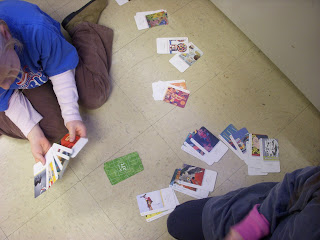 |
| Go Fish! in Art playing cards are very popular. They can also play it as a Match The Art Game and often tell me, "I've seen that before!" when I show and talk about famous artists work that we study. |
I know you're thinking, "Oh mylanta, why spend all of your money doing this?" I can't help it. I am a child at heart and LOVE these free time art toys etc. probably more than them and yes, I know that they're going to rough them up aka destroy them overtime, but it's all about the experience, you know, and seeing them enjoy and connect with art. If 1 student says, "Do you remember how amazing art time was in Miss Oetken's Room?" or "Hey, I remember seeing that painting in one of Miss Oetken's books!", then it was TOTALLY worth it!
Tuesday, January 18, 2011
How 'baby dots' have been life changing in an art room!(could be yours too!)
Okay, so you're reading this and you're thinking, "Uh, what is she talking about? Baby dots? What?" The way you explain something, especially putting a positive spin on things, changes everything! For example. How many of you have this problem in your classroom: You use glue and that equals a) a big mess b) wasted glue! c) requires more clean up time for the messes and d) requires you to invest and plan ahead to order more glue (and take more out of your budget!). Glue sometimes can equal disaster. From the beginning of the year till now, I like to find creative, short effective ways that really stick in understanding procedure for students. So naturally in this case you think, Okay, I'll just tell the students to use less glue. 9 out of 10 times students don't really understand that concept, because what's less for someone isn't less for another student. They'll say, "What? I used less?" and it resembles something of big sloppy mess of a glue mountain or lake. So in other words, you need a constant. Something that is the same for everyone. When I talk about gluing, I introduced "baby dots". I SHOWED the students what tiny baby dots look like, included "no mom or dad dots are invited the party! Just the babies! Oh, and the babies, can't be next to each other, because if they do they start crying! Shhh, good baby dots." I say as I demonstrate on a project. I also say, "Whoops! Whoa! That was a big dot, I think it's Daddy dot! He's not invited?! Return to the baby dots. Shh, gooooood baby dots!". They laugh and remember. I also check for understanding the next few times by saying, okay time, for glue but who's invited to the party?!" STUDENTS: "Baby dots!" Then I'll say, shhh...don't wake the babies!Instead of saying "Whoa, that is too much glue!", I might say "Are those baby dots? They look a lot like daddy dots, or mama dots?" Students then relate that to size and know they have to go smaller. I now can estimate how many dots for attaching projects! For example, for Kindergarten, they needed to cut out a 2" square and attach it. I simply say, "How many baby dots do you think we should put on it? I think about 3 baby dots should work just fine! How many baby dots? STUDENTS: "3!" Then I say, "Shhhh, yes, but don't wake the babies!" They love it and remember.
I have found that this system works wonders and is a positive way of understanding! Because of following this. During clean up time, guess what? MESS ELIMINATED! Only washing small areas instead of scrubbing a whole table, and sometimes no mess at ALL! Less work for them & faster! I hardly have to fill glue bottles! Don't have to buy more extra gallons of glue!(I always need to have some on hand for big project though). The way you explain something really makes a difference!
I have found that this system works wonders and is a positive way of understanding! Because of following this. During clean up time, guess what? MESS ELIMINATED! Only washing small areas instead of scrubbing a whole table, and sometimes no mess at ALL! Less work for them & faster! I hardly have to fill glue bottles! Don't have to buy more extra gallons of glue!(I always need to have some on hand for big project though). The way you explain something really makes a difference!
Subscribe to:
Posts (Atom)