Check out what we're studying in ART!

Showing posts with label 4th grade. Show all posts

Thursday, April 19, 2012

Art Careers Exploration!: Artists Talk About their Professions & Requirements in the 21st Century


What an excited, eventful day we had in the art room! I surprised my 4th graders with celebrities! Real, successful, and unique artists from Des Moines! I asked Kristian Day and Jon Baldwin from the Des Moines, Iowa area to come and talk to my students about how amazing their jobs are, but also talk about what it really takes to be a successful part of the art world in the 21st century (especially with it's challenges and competition).

Kristian showing the students his Super 8 camera a vintage model that he loves to use and explains how it works. You might have heard of the Steven Spielburg 's movie, "Super 8" which is named after this type of camera.

Kristian Day is a successful independent film maker who has made some very successful documentaries. They have taken the Des Moines area by storm and sweeping across the nation! I attended a screening of one of his documentaries at the Des Moines Art Festival this past summer called "Hybrid Pioneer". It follows the life and eye into the unique style and life of the area artist Brent Housenga (more about Brent: http://www.brenthouzenga.com/  and clips of Kristian's documentary). Kristian not only films but he does all the sound and editing. He is a composer and likes to take clips from his film and others and compose music to produce an artistic installation like experience. Absolutely amazing.


Most recently his documentary called "Capone's Whiskey: The Story of Templeton Rye" which is the history of  Iowa's role in the illegal moonshine production and creation of the famous brand Templeton Rye during the rich history of prohibition. Kristian actually got people, from over generations of staying quiet, to reveal their most intimate stories of famous history that had never been uncovered till now! You might have heard PBS having a documentary film series called "Prohibition". PBS aired Kristian's documentary right after it!!!! I watched it on PBS the first time. Then Kristian invited us to his documentary's premire at the Fleur Cinema and Cafe where many of the people interviewed were also attending to see it on the big screen. 

Kristian explained how filming works and how sound is recorded. He also passed around mini posters of his new film he's working on with a friend and film maker called "Kung Fu Graffiti"  (http://www.kungfugraffiti.com/about.html) and mentioned he would love to do a screening here in Grinnell! He travels all around the world to film festivals to showcase and share his films.


Jon Baldwin is a successful visual artist in Des Moines. We works in all different kinds of media from drawing to painting to printing. He's very versatile. He shows in galleries whenever possible and has a thriving buisness of selling his visual productions. Jon also does commissions for buyers. Jon really did a great job of expressing how important passion is in your art and staying true to yourself. Don't be hurt by others when they say when they don't like your art. Take it in and take something away from it to learn about what you do. However, sometimes you have to cooperate and make changes within the way you make your art for a customer to make them happy. It is a business and you sometimes have to sacrifice your personal ideas to make your customer happy to create a good reputation. However, don't loose yourself and change to conform to everyone's liking. Jon explained you don't have to have the highest quality of art supplies to make successful art. He mentioned he uses all kinds of media including the same brands that we use in our art classroom!

Jon knew we had been studying amazing artists like Vincent Van Gogh and wanted
to point out his striking resemblance along with how he's inspired by other artists' styles


students looking at Jon's art that was inspired by childhood interests
Both artists explained how important is to keep learning, asking, inquiring, exploring, and discovering in their field. They are lifelong learners. As soon as you stop wanting to learn and grow, you loose out on opportunities to be successful and overcome the competition. Artists are hardworking who don't ever stop wanting to be successful. Passion is their main drive to work through obsticles and creativity is what helps them overcome these obstacles. What inspired my students was the fact both artists said their career decision was made and inspired by art during their elementary years of childhood! Most of their art comes from concepts they discovered and loved as a child. I agreed with both artists when they said "Artists are really just kids at heart. We love to have fun through creating and sharing our ideas with others. Art is the way we communicate."


students asked Jon and Kristian for autographs after holding discussion with the class
What was more amazing than anything was the fact that my students held great discussion and questions with our artists. They asked thought provoking questions about their jobs and it was so great to see the critical thinking skills and inquiring ways of my students. I would jump in and ask my students questions back and also ask questions in relation with 21st century skills. Here's more information about Kristian.   http://www.kristianday.com/

Friday, March 23, 2012

Picasso Cubism Self Portraits


4th graders learned about Cubism and the founders of this art movement, Pablo Picasso and Georges Braque (just for the record I totally messed up the pronounciation when I talked about Georges Braque. How do you find proper pronounciations?! HERE!!!--->http://inogolo.com/  Amazing. We looked at a powerpoint all about Cubism (presentations.pppst.com/isms-cubism.ppt). It does a nice job of providing discussion and visual with the class and explains Picasso and his periods (blue and rose) and examples. It also does a nice job of explaing what Cubism really is- a way of making art by combining all different views of an object or person into a painting or a single drawing plane. We looked at painting within the power point and a lot of Picasso's portraits of people.


4th graders learned how to make a distorted Cubist self portrait using black glue to outline and then bright watercolor and pattern! We first traced a skinny rectangle that would become the distorted head/face. Then made a creative line down the middle, making sure to add the nose. We talked about characteristics of Picasso's portraits like the large noses and how the eyes were always uneven because of different views combined. We also talked about making funky creative ears, eye brows, and lashes.


The next classtime, we used our new double tray PRANG watercolors. I showed students how to use the cover with the compartments to mix colors of their own. We also learned a technique to do line work and pattern with watercolor. Pretty cool results!


Friday, March 2, 2012

Jim Dine Decorated (paper) Sugar Cookies


Jim Dine was our inspiration for these freshly baked "paper" sugar cookies! I found a bunch of aging manilla paper and cut it in half to form a 6x12 pieces and had seen an art lesson like this on Artsonia a while back. We discussed and looked at heart art by Jim Dine. For this lesson I really wanted to keep the creativity open so I simply gave them the criteria and order of supplies to be used and brainstormed with them.


First students traced hearts (4, 2 on each sheet of 6x12. This cut down on time and frustration of trying to fit 4 hearts on a 12x12) with pencil. Then cut out. This is the sugar cookie dough!


Meanwhile, paint with either pink or red on the ribbed outside edge of the plate. That's the only part that will show because of the lace doily and cookies overlaping on top. While the paint is drying. I tell students to trace their sugar cookie heart on the colored 'icing' or colored construction paper. I had lots of different pinks and red out of cut construction paper. Then fold in half to trim the outter edge all the way around to make it smaller so when you glue it on, you'll still see the sugar cookie edge. I told students to think about adding sprinkles and pattern by drawing it on or coloring it in with oil pastels.


some students came up with the creative concept to make it look more like
a true cookie by making it look like a bite was taken out of it


After icing and detail is added, I told students to glue the hearts to the doily incase your plate with paint on it is still drying. If ready and slightly wet, you can still glue on the doily, just be careful. Then, for the best for last. I had out white shiny Tulip fabric paint with some red glitter, pink glitter, and silver glitter fabric paints. I said it gives it the detail and effect of piped frosting! Neato. Oh and it gets better. I had a 'crystal sugar' (clear crystal glitter, not real sugar) station that you can sprinkle on if desired for the crystal sugar effect and it sticks to the fabric paint. The key is to keeping the small container of glitter in a box, putting the plate in the box, sprinkling the glitter, shaking it and then removing it. This conserves the glitter and the mess. It's easy to take the leftover glitter in the box and pour it back in the glitter container to be used again, and there's no real big mess everywhere either for our custodian!


supply table


student work. Look a heart arrow and glitter piped frosting!


good enough to eat!


Friday, December 16, 2011

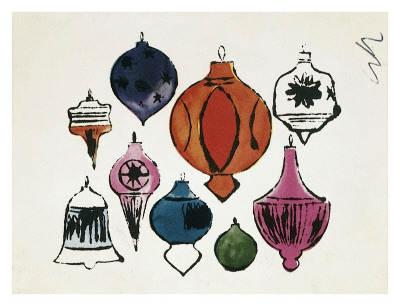
Andy Warhol ink blotted line ornaments!


4th graders learned a little bit about the artist Andy Warhol and his special blotted line technique. He started his first prints with this process where he would draw with wet ink and before it dried he would lay a paper on top. Then smooth the back and peel off to produce a textured, uneven lined print. He was soon hired to make advertisements for shoes in Vogue magazine using this technique. He even made some holiday themed ones (the ones from below). We made our own ornaments using the same technique! Then filled in with pattern and line pattern with lots of color! Check em out!


place copy underneath the clear printing plate then carefully using plastic bristle
brushes, dip into 'ink' (watered down black paint)

Then quickly before it dries, place a paper on top without moving it around

...then peel off to reveal print!

this student went very in depth with their pattern using pencil first befor filling in with colored pencil!

...we drew a string hanging from each with a rectangle to show where the metal piece holds onto the ornament 


Wednesday, December 14, 2011

Monet's Waterlilies

http://artasticartists.blogspot.com/2011/03/going-greek-scratch-into-history-with.html
4th graders are finishing their Monet unit and learning about the man who started Impression! We made our own Monet-esque painting and 3-D waterlilies. Click on the link above to take you to the indepth post!

Wednesday, December 7, 2011

Grinnell College's Gallery visits with Kara Walker Silhouette explorations!


Tilly Woodward, amazing photo-realist style artist and director of art outreach/community like programs, came with a student from the Grinnell College Falconer gallery to show a 1st grade class and kindergarten class, all about Kara Walker! Kara Walker is famous for her controversial themed  black cut paper silhouettes.

Students really enjoyed a change of pace and what was even better, was that they finally got a chance to talk about their art with the class. I LOVED that part. It's hard to find that time in the classroom to have everyone sit down and share! We need to do that more often.

Students first drew with white chalk a simple drawing. Then cut out and glued the sihoette 'chalk face' down, so you could only see the black paper. They attached it to an interesting background.

students look at a photo copy of a famous Kara Walker


Students got a kick out of talking about their art and what made their 'Kara Walker' unique!


Last year Tilly and her volunteers came in to talk about Japanese woodcut prints with the students and then 4th graders got to work on making their own prints with foam tray print making! The students were so wowed by the ancient book of Japanese woodcut prints and LOVED using all the bright inks, authentic barens, bright tissue papers! Japanese woodblock printing is ancient artform and everything from the inks, to the process, to actually making a registration...is a very respected and intricate, delicate process.